Posts

The Case for a Medium-Weight Anti-Ship Cruise Missile

Image
MALD The DARPA, the Navy, and Air Force are currently funding the Offensive Anti-Surface Warfare (OASuW) Weapon Development program.  This intends to replace the decades-old Harpoon Anti-Ship Missle (AShM) on Navy warships with a new weapon, and develop an air-launched variant for Air Force bombers, as well as Navy and Air Force tactical aircraft. The candidate weapons include an anti-ship variant of the time-tested Tomahawk.  An anti-ship version of the USAF JASSM missile (LRASM). And the Konsgberg JSM/NSM. Konsgberg NSM and JSM All have pros and cons, and ultimately a mix may be the most appropriate. All of these share one thing in common, they are meant to kill relatively large warships. Warhead weight: Tomahawk - 450kg blast-frag LRASM - 450kg penetrating blast-frag NSM/JSM - 125kg blast-frag For comparison: Exocet - 165kg blast-frag Harpoon - 221kg blast-frag However, most warships we will face are not  very large.  The Chinese Navy...

Pimp My S/IBCT - Round 2 - Bring Back the Independent Tank Battalion

Image
M1A2 SEPv3 In the previous Pimp My IBCT, I suggested using a combination of refurbished M-ATVs to achieve full vehicular mobility for some IBCTs.  This would give them a degree of tactical and operational mobility near that of the Stryker BCTs.   They would suffer off-road, in comparison to the SBCT, but would be at least as mobile on roads, with lower logistics overhead. However both SBCTs and mounted IBCTs are still severely hamstrung if used offensively.  The Stryker ICV is protected against 14.5mm HMGs organically, and partially protected against RPG-7s with slat armor.   It is not protected against heavier RPGs (e.g. RPG-29) or any ATGMs. M-ATV is protected against 7.62mm rounds only.  So even this guy would ruin its day. Source: Wikipedia Aggressive, offensive use of either BCT type against foes with anti-armor systems, or in built-up areas, would likely result in heavy casualties.  Both BCT types will be stuck either dis...

New Family of Missiles for the Infantry

Image
Rationale  Man-portable and vehicle-mounted Anti-Tank Guided Missiles (ATGMs) have shown value across the combat spectrum.  Even in conflicts without significant armor threats, these missiles have been used as long-range bunker busters and anti-personnel munitions.  Uday and Qusay Hussein reportedly died in their house under an intense TOW barrage. Uday and Qusay Hussein's house under attack by TOW missiles ATGMs also form the cornerstone of anti-armor capabilities for light and medium units, and significantly enhance the anti-armor firepower of heavy units. Background The US Army has been stuck in a missile rut for some time now.  After the failures of EFOG-M and Netfires/NLOS-LS, the Army appears content to produce minor updates to Javelin and TOW anti-tank missiles. However other countries, notably Israel, have moved on in dramatic fashion. The Rafael Spike family of missiles has expanded to include five distinct variants. Mini-Spike Ra...

Pimp My IBCT

Image
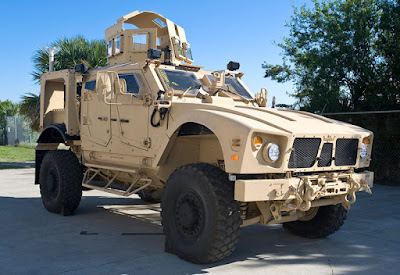
Oshkosh M-ATV with Objective Gunner Protection Kit (OGPK) The Center for Strategic and Budgetary Assessments (CSBA) recently conducted multi-think tank exercise entitled " HOW MUCH IS ENOUGH? ALTERNATIVE DEFENSE STRATEGIES ". In it, they enlisted the American Enterprise Institute (AEI), the CATO Institute,  Center for a New American Security (CNAS), and the Center for Strategic and International Studies (CSIS) to weigh in on alternative strategies and force structures for the US Military. Each team presented a set of force level changes for each service, and the CSBA compared them to the current baseline plan. For the Army, most teams significantly cut the number of Infantry Brigade Combat Teams (IBCTs) in the force model. Most also increased the number of heavy ABCTs, reflecting their renewed emphasis on conventional conflicts. However, if we look at the resulting structures, IBCTs still comprise a significant portion (9-12 IBCTs out of ~30 total) of the ...

On Phasers and Photon Torpedoes

Image
Multiple, recent papers from the Navy think tank community 1 has espoused the benefits of solid state lasers (SSLs), electromagnetic rail guns and hyper velocity projectiles (HVPs) to increase the magazine depth of Navy ships when defending against cruise and ballistic missile strikes. LaWS on Ponce However none of these technologies has come close to shooting down even simulated cruise missiles.  At best SSLs have shot down small, light weight UAVs. BAE HVP Current HVP programs haven't even done this.  They are still heavily in the research phase. The one exception is the OTO Melara Strales/DART program, which appears to be far closer to production.  However, it is purely a Close-in Weapon System (CIWS) replacement.   It's unclear to me how many successful tests of this system have occurred. OTO Melara Strales 76mm gun OTO Melara DART munition Before we "bet the farm" on the transformational power of SSLs and HVPs to allow ou...

Have to start somewhere

Yes, nothing here yet. Time and a general lack of unique content has prevented me from posting anything.