Posts

Showing posts with the label IBCT

Pimp my BCT - The Budget HAPC Transport Battalion

Image
M1-based HAPC The existing Army Brigade Combat Team organizations contain a variety of infantry carriers, from un-armored trucks to Strykers and Bradley Fighting Vehicles.  However, none of them match the protection of an MBT.  Aggressive use of these vehicles in high-intensity/high-threat situations, such as urban combat against well equipped enemies, could lead to catastrophic losses.  Assaulting a prepared enemy position, where the enemy has a large number of anti-armor munitions is a very dangerous proposition in a Bradley or Stryker.  Both will require their infantry to dismount well before the objective and approach on foot, negating the closing speed afforded by vehicles.   The Army attempted to remedy this with the Ground Combat Vehicle (GCV) program.  This program envisioned an MBT-sized vehicle carrying a full squad, with high levels of all around protection.   However, it was canceled due to the forecast high cost. GCV (Notional - ...

Pimp My SBCT Round 3 - The Amphibious Assault Brigade Combat Team (AABCT)

Image
The USMC is moving away from large-scale amphibious assaults towards smaller, battalion-and-below formations and EABO.  However, the US Military may still find itself in need of performing such an assault as part of a broader forcible-entry operation. What’s needed is a “relatively” inexpensive way to land a large, mobile, armored force in short order.   So how about give the large-scale amphibious assault mission to the Army?  Switch three IBCTs (roughly a division) over to an Amphibious Assault Brigade Combat Team (AABCT), an organization mirroring the SBCT, but replacing the ~300 Strykers with the USMC ACV. USMC ACV with 30mm Remote Turret SBCT Organization ( CBO ) SBCT Organization Pg 2 In this way, existing, land-based SBCT doctrine and training could remain the same.  The AABCT can be used in more or less the same ways and same situations as an SBCT.  ACVs are somewhat heavier and larger than Strykers so the logistics elements in the SBCT will need a bit o...

Pimp My S/IBCT - Round 2 - Bring Back the Independent Tank Battalion

Image
M1A2 SEPv3 In the previous Pimp My IBCT, I suggested using a combination of refurbished M-ATVs to achieve full vehicular mobility for some IBCTs.  This would give them a degree of tactical and operational mobility near that of the Stryker BCTs.   They would suffer off-road, in comparison to the SBCT, but would be at least as mobile on roads, with lower logistics overhead. However both SBCTs and mounted IBCTs are still severely hamstrung if used offensively.  The Stryker ICV is protected against 14.5mm HMGs organically, and partially protected against RPG-7s with slat armor.   It is not protected against heavier RPGs (e.g. RPG-29) or any ATGMs. M-ATV is protected against 7.62mm rounds only.  So even this guy would ruin its day. Source: Wikipedia Aggressive, offensive use of either BCT type against foes with anti-armor systems, or in built-up areas, would likely result in heavy casualties.  Both BCT types will be stuck either dis...

Pimp My IBCT

Image
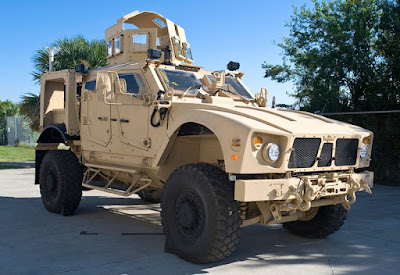
Oshkosh M-ATV with Objective Gunner Protection Kit (OGPK) The Center for Strategic and Budgetary Assessments (CSBA) recently conducted multi-think tank exercise entitled " HOW MUCH IS ENOUGH? ALTERNATIVE DEFENSE STRATEGIES ". In it, they enlisted the American Enterprise Institute (AEI), the CATO Institute,  Center for a New American Security (CNAS), and the Center for Strategic and International Studies (CSIS) to weigh in on alternative strategies and force structures for the US Military. Each team presented a set of force level changes for each service, and the CSBA compared them to the current baseline plan. For the Army, most teams significantly cut the number of Infantry Brigade Combat Teams (IBCTs) in the force model. Most also increased the number of heavy ABCTs, reflecting their renewed emphasis on conventional conflicts. However, if we look at the resulting structures, IBCTs still comprise a significant portion (9-12 IBCTs out of ~30 total) of the ...